

South Florida, Waterways, and Wardrobes
Why the Ecofriendliest garment care matters differently when the life around you is shaped by bays, canals, coastlines, and the clothes that move between them.
In South Florida, water is never merely scenery. It is geography, atmosphere, social stage, weather system, property line, and recurring source of unease all at once. It glitters beyond dining rooms in Coconut Grove. It slips behind hedges in Palm Beach. It frames arrivals in Miami Beach and long departures from private docks. It is there in the canals, the marinas, the inlets, the mangrove edges, the causeways, the terraces facing Biscayne Bay, and the private homes whose windows seem designed to turn blue water into a permanent interior finish. Miami-Dade describes Biscayne Bay as a “dynamic and diverse marine ecosystem,” while also noting the long history of dredging, filling, canal construction, and development that has altered it over time. The county also notes that the Biscayne Aquifer sits just below ground level in porous rock and provides most of the drinking water used by South Florida residents, visitors, and businesses.
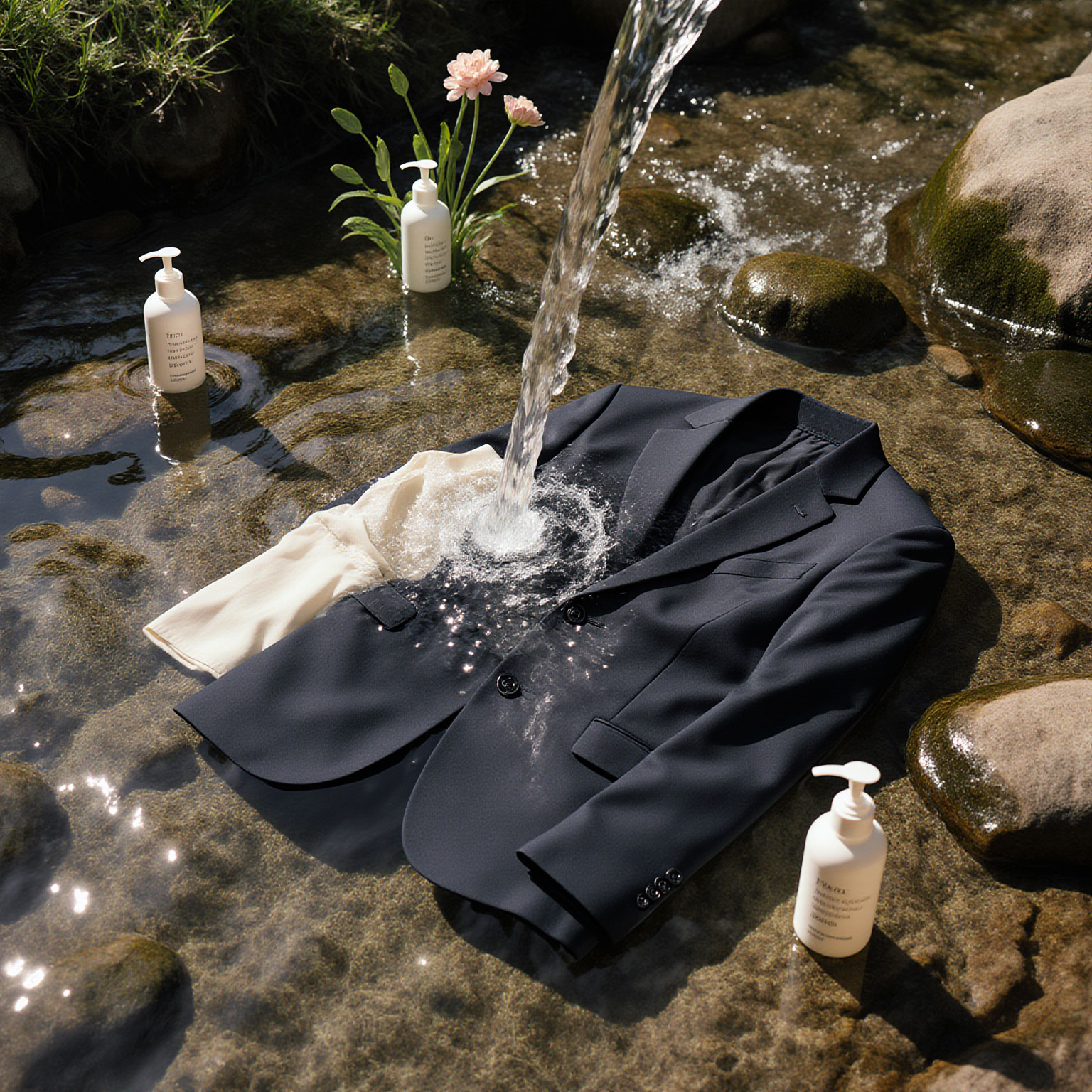
To live well here is to live with that reality, whether one speaks of it often or not. Water defines the fantasy of South Florida, and it defines the fragility beneath the fantasy too. It shapes the social life of the region no less than the ecological one. A woman may leave a waterfront apartment in Surfside in a cream silk Valentino dress for a museum dinner by the bay. A man may step from a car in Palm Beach in a midnight-blue Kiton jacket on his way to a dinner during the Palm Beach International Boat Show, which runs March 25 to 29, 2026 along Flagler Drive. A collector may move from a private lunch near the water to Art Basel Miami Beach, which returns December 4 to 6, 2026. The region’s calendar is threaded through shorelines and causeways so completely that the wardrobe itself begins to feel aquatic in its habits: linen, silk, fine cotton, cashmere for overcooled interiors, eveningwear that must survive sea air and ceremony in the same breath.
This is one reason the question of garment care feels unusually local here. In many cities, cleaning clothes can still be treated as a generic service, detached from place. In South Florida, that seems naïve. The wardrobe does not float above the environment. It lives inside it. Beautiful garments move through heat, humidity, salt air, sunscreen, fragrance, long drives over water, terrace dinners, yacht decks, museum evenings, and homes where the distinction between indoors and outdoors is more porous than architecture likes to admit. To care for luxury clothing here without thinking about water, softness, chemistry, and environmental consequence would be to misunderstand the region itself.
Sudsies understands that South Florida is not merely a market. It is a condition. Sudsies provides the Ecofriendliest garment care for wardrobes that belong to a place where private refinement and environmental awareness increasingly meet. This is not because the people who dress beautifully here have become ascetics. South Florida will never be a place of renunciation. It likes spectacle too much. It likes pleasure too much. It likes arrivals, terraces, floral tables, polished boats, and white jackets at dusk. But beneath the appetite for beauty there is a parallel intelligence taking shape, especially among the region’s HNWI households: a sense that stewardship is now part of sophistication.
Vivienne Westwood’s famous instruction, “Buy less, choose well, make it last,” is quoted so often because it says in plain language what luxury has been slowly relearning in practice. The most refined wardrobe is not always the newest or the loudest. It is the one in which the right garments remain alive. A white Brunello Cucinelli dinner jacket still looks fresh after seasons of wear. A black Saint Laurent tuxedo still falls properly after gala season. A Loro Piana wrap still feels like indulgence rather than maintenance. A silk Miu Miu dress bought in Bal Harbour and worn first for a winter dinner in Palm Beach, then again months later for an evening by the bay, still moves with its original confidence. This continuity is not accidental. It is the result of care.
And care, in South Florida, has environmental implications that feel impossible to dismiss as abstract. Miami-Dade notes that the Biscayne Aquifer is close to the surface and formed within porous rock, while county floodplain materials emphasize that wetlands protect water quality and provide groundwater recharge to the aquifer. These are not conditions that invite complacency about harsher chemical practices. They invite the opposite: a more exacting standard about what enters the broader life of the region and what kind of stewardship a modern luxury service should embody.
This is where the Ecofriendliest proposition at Sudsies becomes more than a service feature. It becomes a local ethic. Sudsies avoids PERC and other harsh solvents associated with older models of traditional dry cleaning. That matters for garments, of course. It matters for softness, finish, color, drape, and the intimate comfort of clothing that lives close to the skin. But in South Florida it also matters symbolically. It signals that garment care can evolve with the place in which it operates. It signals that luxury need not cling to older industrial habits simply because they were once normal. It signals that a region built around bays, canals, marinas, and aquifer sensitivity deserves a gentler and more intelligent approach.
There is something deeply South Floridian in this balance between glamour and vigilance. One sees it in the homes that look effortlessly open to the outdoors while being meticulously managed against moisture, heat, and salt. One sees it in the way people dress for the Palm Beach International Boat Show or for a dinner after Art Basel, understanding perfectly well that silk, linen, fine wool, and white cotton must contend with actual climate rather than editorial fantasy. One sees it in the woman who carries a Hermès shawl into an overcooled room after arriving through damp evening air, or the man whose Isaia shirt must still feel comfortable after a long dinner that began near the water and ended somewhere quieter inland. Clothing here performs under conditions that demand subtlety. It should be cared for with equal subtlety.
That subtlety begins with the refusal to confuse harshness with seriousness. For too long, traditional dry cleaning carried the aura of industrial certainty. The garment came back with a smell, a crispness, a sense that something decisive had been done to it. Yet the modern luxury wardrobe has become less willing to tolerate that old proof of process. A silk blouse should not smell chemically corrected. A dinner jacket should not feel as though its fabric has been briefly alienated from itself. A white shirt should not return technically perfect but sensorially diminished. The guest experience matters, and in South Florida it matters intensely because garments are worn so bodily here. Heat, humidity, and skin make everything more immediate.
Stella McCartney once said that “the most sustainable thing you can do as a designer, is to create pieces that people want and won’t want to throw away.” Sudsies extends that logic from creation to maintenance. The question is not merely whether a garment can be cleaned. The question is whether it can be returned in a condition that preserves desire. Will the cream jacket still feel fresh and supple enough to be worn to another dinner? Will the silk dress still merit another invitation? Will the cashmere layer still carry the softness that made it part of the wardrobe’s inner circle? A garment abandoned because it no longer feels right is a kind of quiet waste, even when no one names it that way.
This is why preservation, in South Florida, often feels like the true luxury discipline. Not acquisition alone, but continuation. Andrew Bolton’s observation that “longevity is a key aspect” of sustainability belongs here as much as it does in any museum conversation. The region’s best wardrobes are not composed only of newness. They are composed of return: the gown worn again because it remains beautiful, the tuxedo kept in service because it has not been brutalized by care, the linen pieces that survive another season because someone understood how to protect them from both climate and process.
Sudsies approaches this as part of the hidden infrastructure of a well-run South Florida life. Pickup and delivery matter because the lives being served are full. Garments may be collected from a waterfront residence, a building concierge, an office in Coral Gables, or a Palm Beach home preparing for a weekend of entertaining. They return not simply cleaned, but reintroduced into the rhythm of the household. In homes where the best systems are the least visible, this matters enormously. The flowers arrive before guests. The car is waiting before departure. The white dinner shirts are back before the next event. Service does not perform itself. It dissolves into continuity.
Brunello Cucinelli once explained his attraction to cashmere by saying, “you don’t throw it away.” It is difficult to imagine a better expression of what South Florida’s most intelligent wardrobes now require. The finest garments are not made for disposal, and they should not be cared for as though replacement were the most elegant answer. This applies as much to an ivory dinner jacket worn for a charity evening in Palm Beach as to a black Valentino gown worn at a museum dinner near Biscayne Bay. The point is not to make clothing precious in the brittle sense. The point is to make it last in the cultivated sense.
South Florida, Waterways, and Wardrobes is therefore not a niche concern. It is a way of understanding that clothing, climate, domestic life, and regional ecology are more intertwined than they first appear. A garment is worn beside water, over bridges, through humid air, into rooms kept cool against the outside heat. It is then cleaned somewhere in the same broader environment, by methods that either reflect a newer regional intelligence or remain trapped in an older one. Sudsies has chosen the former path. The Ecofriendliest garment care is not just a claim about process. It is a statement about belonging to South Florida responsibly and elegantly at once.
That may be the region’s real test now. Not whether it can keep producing beauty, because it always will. But whether that beauty can be supported by systems with enough intelligence to deserve the setting. Sudsies answers that question quietly, through garments that return fresh, comfortable, and still fully themselves, and through a care philosophy that feels right for a place where water is too present, too precious, and too defining to be ignored.
In South Florida, even the most private wardrobe belongs, in some subtle way, to the life of the landscape around it. And the most modern luxury may simply be knowing that how you care for beautiful things is part of how you live in a beautiful place.