

A Softer Return
Why garments cleaned without harsh solvents feel fresher, wear better, and belong more naturally to the well-dressed life of South Florida.
In South Florida, clothes are asked to live many lives in a single week. A white Brunello Cucinelli dinner shirt may go from a board dinner in Coral Gables to a waterfront supper after Thursdays at PAMM. A Valentino silk blouse may appear beneath a softly cut cream suit for lunch in Palm Beach, then return a few nights later under a black jacket for a collector dinner during Miami Art Week. A Kiton dinner jacket may spend one evening at Florida Grand Opera and another, months later, at a private terrace dinner after Art Basel Miami Beach, which is scheduled for December 4 to 6, 2026. Florida Grand Opera’s current programming includes its 2026 gala, while PAMM continues its weekly Thursday evening series on the waterfront.
This is not a climate, nor a culture, in which clothing can afford to feel remote from the body. Garments here must breathe, move, recover, and return gracefully. They live in humidity, among fragrance and sunscreen, beneath warm arrivals and overcooled interiors, through long dinners, museum evenings, performances, charity events, and impromptu weekends away. The South Florida wardrobe may look effortless from across the room, though it is often maintained through exacting private systems. Those systems matter because the difference between a garment that remains inviting and one that quietly falls out of favor is often surprisingly small.
One of the smallest and most revealing differences is how a garment feels when it comes back after care.
There are clothes that return looking technically immaculate while carrying a faint sense of interruption. The line is there, the press is there, the appearance is in order, and yet something has shifted. The silk no longer glides quite so easily. The wool has a drier hand. The cotton shirt feels sharpened beyond comfort. The dress smells not of freshness, but of process. What one notices, in other words, is not the garment, but what has been done to it. This has long been accepted as one of the mild indignities of traditional dry cleaning, particularly for those who grew up associating formal garment care with chemical odor and a certain industrial stiffness.
Now, however, that old compromise feels increasingly out of date. The modern luxury wardrobe asks for something better. It asks not merely to be cleaned, but to be returned to use in a condition that still feels intimate, wearable, and true. This is where Sudsies has quietly distinguished itself. The Ecofriendliest garment care at Sudsies begins with the idea that the most refined result is often the least aggressive one. The garment should come back fresher, softer where softness matters, structured where structure matters, and free from the sharp chemical afterimage that once passed for professionalism.
A softer return is, on the surface, a sensory pleasure. Yet it is also an important cultural clue. It suggests a different understanding of luxury, one rooted not in display alone, but in stewardship. Truly elegant clothing is not merely admired from a distance. It is lived in, worn close to the skin, and expected to remain pleasurable through repeated use. A cream Loro Piana overshirt, a black The Row dress, a softly tailored Zegna jacket, a white cotton Tom Ford evening shirt, a cashmere wrap carried into an overcooled ballroom, all of these depend on touch as much as on appearance. They ask not only to be seen beautifully, but to feel beautiful too.
This is why harshness in garment care has become harder to tolerate. A garment that returns with chemical odor feels, immediately, less luxurious. A jacket that has lost suppleness may still appear handsome on a hanger, though the body knows the truth the moment it is worn. A silk blouse that has been overhandled may still catch the light, though it no longer collaborates with movement in quite the same way. Luxury garments live or die by nuance, and nuance is often what harsh systems erode first.
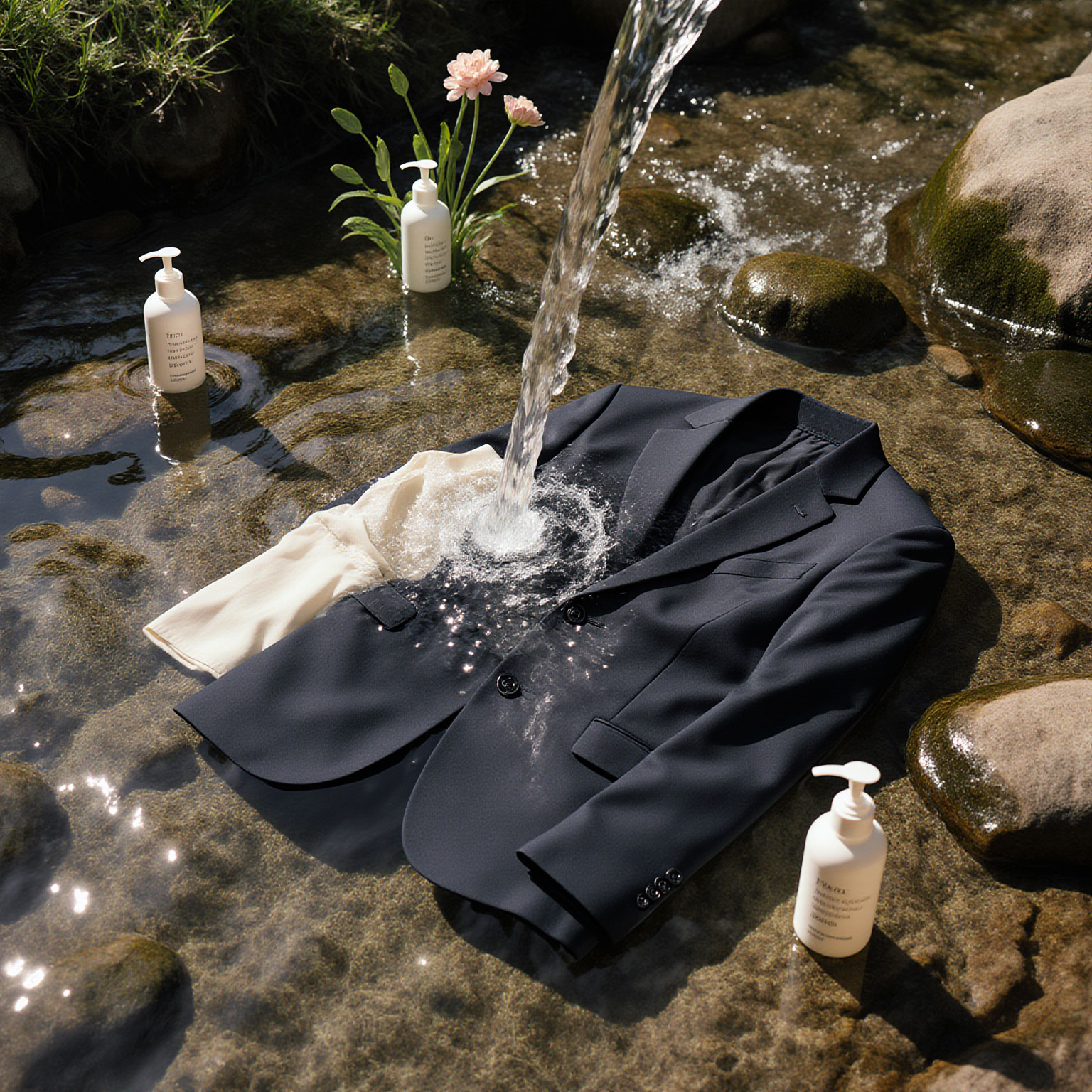
At Sudsies, the softer return begins with chemistry, though it does not end there. Sudsies avoids PERC and other harsh solvents associated with older dry-cleaning models. That matters for the environment, certainly, though for the guest the difference is often immediate and personal. Garments come back fresher, more comfortable, and less burdened by the smell that once made people hang things near an open window before wearing them. The experience of dressing becomes more seamless because the garment feels as though it has been cared for rather than processed.
Yet the real sophistication lies in what accompanies this choice. Not every garment should be treated alike. A Saint Laurent tuxedo, a Miu Miu faille cocktail dress, an Isaia dinner jacket, an Oscar de la Renta embroidered gown, and a Brunello Cucinelli cashmere polo all carry different needs. Construction matters. Fiber matters. Lining matters. Embellishment, drape, structure, and finish all matter. Sudsies understands that the right result is achieved not by forcing all clothes through one dominant method, but by reading each piece carefully and selecting the gentlest intelligent path.
This is one reason a softer return often signals a more accomplished garment care philosophy overall. It tells you that someone has respected the hand of the fabric. It tells you that softness was preserved where softness belongs, that shape was restored without creating rigidity, that freshness was achieved without leaving a garment smelling like the mechanism used to clean it. It tells you, perhaps most importantly, that the service recognizes the difference between a garment that is merely cleaned and one that is restored to actual wearability.
In South Florida, where the wardrobe is often in near-constant motion, this distinction becomes especially meaningful. The woman dressing for a performance at Florida Grand Opera, a dinner in Bal Harbour, or a fundraising evening near the water is rarely interested in treating her clothing as static objects. The man moving between a Palm Beach lunch, a Coral Gables dinner, and a museum event downtown wants a wardrobe that feels ready, not chemically burdened. A softer return supports this style of living because it removes friction from dressing. The silk blouse can be worn again without hesitation. The dinner jacket feels right immediately. The cashmere wrap remains soft enough to justify reaching for it once more.
There is a domestic dimension to this as well. In well-run households, clothes are not isolated from the larger atmosphere of the home. They live in dressing rooms, closets, wardrobes, and guest suites. They are handled by owners, partners, house staff, and sometimes traveling companions. A garment that carries harsh chemical odor changes the mood of these spaces more than people admit. It introduces an industrial note into environments otherwise defined by comfort, polish, and quiet discretion. A softer return, by contrast, feels more in keeping with contemporary domestic luxury. It allows beautiful clothes to reenter the home without bringing a trace of the process loudly in with them.
This may seem like a small thing, though small things are often where genuine standards reside. South Florida’s HNWI households understand this intuitively. They know that the difference between good and truly cultivated service often lies in what does not intrude. The flowers arrive before they are needed. The car is waiting before one asks. The table is set before guests appear. The jacket is returned before the next event, and when it returns, it feels as though nothing unfortunate has happened to it in the interim. Sudsies belongs to this category of quiet competence, where refinement is measured by how little friction remains.
A softer return also changes the lifespan of a wardrobe. Clothes that feel right are worn again. Garments that remain inviting stay in circulation. The black crepe dress returns to another dinner. The tuxedo shirt sees another season. The beautifully cut blazer travels again. The cashmere knit remains part of the weekly rhythm rather than retreating to the back of the closet. In this sense, softness is not merely a comfort issue. It is a longevity issue. A garment stripped of ease is a garment sooner abandoned. A garment preserved in its original pleasures is one more likely to remain part of a life.
This is where the Ecofriendliest proposition at Sudsies becomes especially persuasive. It is not only an environmental position, though it is that. It is also an argument for better luxury, better comfort, and better continuity. The old idea that serious garment care had to announce itself through smell and stiffness now feels oddly primitive. The newer, more intelligent standard is subtler. Clothing should come back clean, certainly, but also alive to the reasons it was chosen in the first place. It should still feel like silk. It should still feel like cashmere. It should still feel like the jacket one loved before it left the house.
For Louise, this is perhaps where the story becomes larger than laundry and more intimate than fashion. A softer return is really about preserving the relationship between a person and the clothes that accompany their life. In South Florida, where dress is entwined with weather, hospitality, travel, entertaining, and social ritual, that relationship is unusually vivid. The wardrobe is not theoretical. It is worn. It participates. It remembers. The best garment care honors that reality.
Sudsies does so by making the return gentle enough to feel natural. Not dramatically softened, not sentimentally described, but simply right. The Valentino blouse still slips on with ease. The Kiton jacket still carries its line. The white evening shirt still feels crisp without feeling deprived of humanity. The garment returns not as evidence of process, but as itself.
That is a softer return. And for the well-dressed life in South Florida, it is one of the quietest luxuries of all.