

After the Party
How Sudsies brings the Ecofriendliest garment care to eveningwear, event dressing, and the private afterlife of beautiful clothes.
In South Florida, evening clothes do not live quietly. They move through a very particular social topography: a black-tie opening night with Florida Grand Opera, a collector dinner during Art Basel Miami Beach, a waterfront benefit at Pérez Art Museum Miami, a wedding weekend in Palm Beach, a late supper after the Palm Beach International Boat Show, a charity gala in Coral Gables where the room is cool but the arrival is warm and humid. Florida Grand Opera’s current season includes Turandot and a 2026 gala, Art Basel Miami Beach lists its next edition for December 4 to 6, 2026, Pérez Art Museum Miami continues to serve as one of the city’s defining waterfront cultural venues, and the Palm Beach International Boat Show is scheduled for March 25 to 29, 2026 along Flagler Drive.
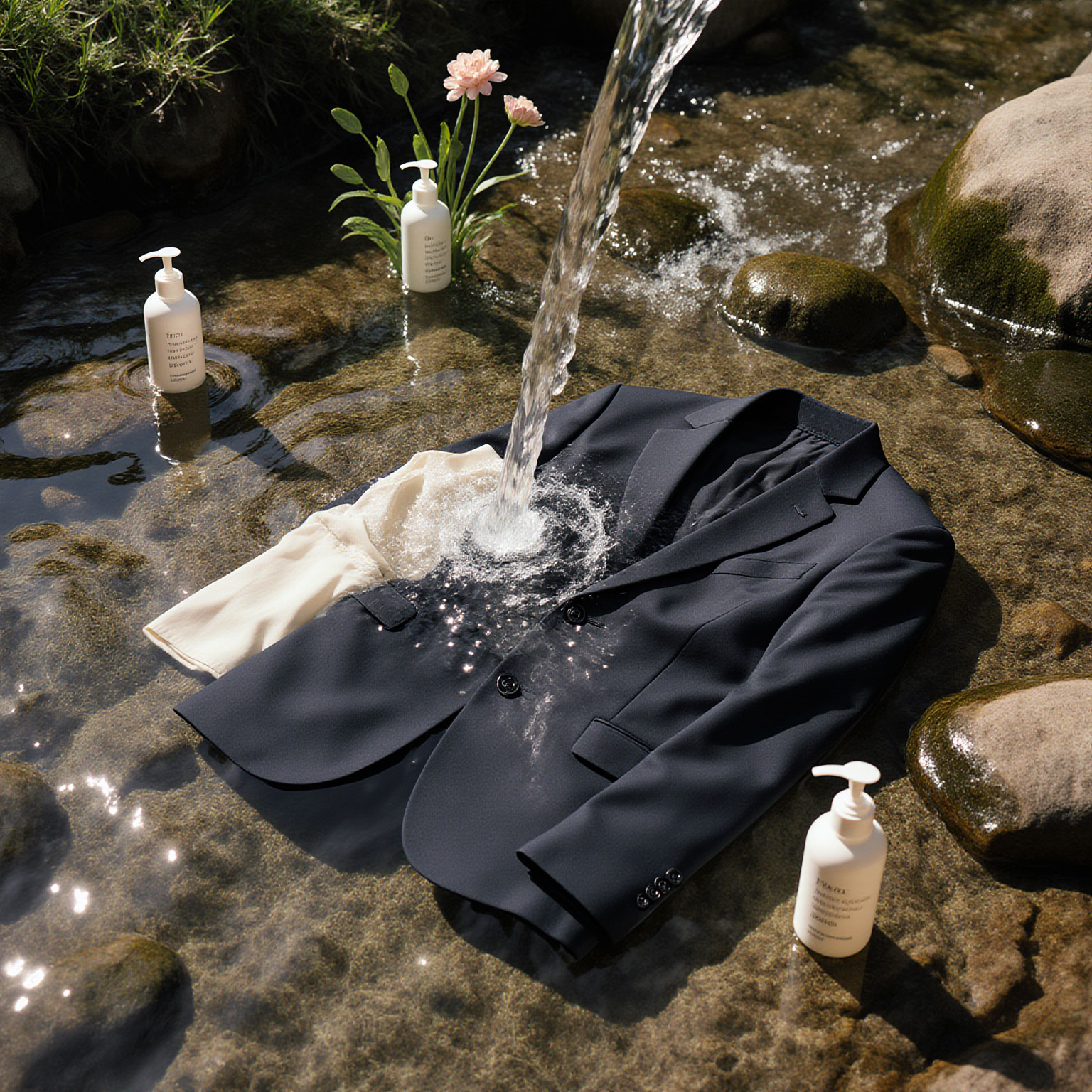
One dresses differently for each of these occasions, though certain garments return as recurring protagonists. A midnight-blue Kiton dinner jacket worn with a soft white formal shirt and perfectly cut black tuxedo trousers. A Valentino silk column gown chosen for its line and restraint. A Miu Miu cocktail dress in black faille that somehow manages to read both playful and precise under evening light. A Gucci tuxedo, a Brunello Cucinelli shawl-collar jacket, a Tom Ford evening shirt, a Dolce & Gabbana lace dress for a gala where one intends, however privately, to be noticed. In Palm Beach, the mood may turn more lacquered and ceremonial. In Miami, it may sharpen toward art, architecture, and atmosphere. In either case, the garment is not merely worn. It performs.
What people rarely consider, at least until they live with fine clothes long enough, is that the real test of eveningwear begins after the room has emptied. Once the driver has pulled away, once the jewelry has been placed back in its box, once the heels have been set aside and the bow tie loosened, the garment enters a quieter and more consequential phase of its life. The silk carries traces of fragrance. The collar holds body heat. A sleeve may have brushed against makeup or a champagne flute. The lining of a dinner jacket remembers the evening differently than its outer cloth does. The satin lapel, the beaded trim, the covered buttons, the feathered cuff, the invisible structure inside a gown, these details may have survived the night beautifully and still be vulnerable to what comes next.
This is where Sudsies enters, not merely as a cleaner of garments, but as one of the unseen institutions that allows South Florida dressing to remain both glamorous and sustainable in the truest sense. Sudsies provides the Ecofriendliest garment care for clothing whose value lies not only in what it cost, but in how exquisitely it was made and how often it deserves to live again.
Eveningwear is, by nature, deceptive. It looks composed while often being technically fragile. A black Saint Laurent tuxedo may appear severe and almost indestructible, though its surface, line, and inner architecture require judgment if they are to remain intact. A fluid silk gown may seem effortless, though that effortlessness is often a highly engineered agreement between bias, weight, seam tension, and drape. A beaded Oscar de la Renta dress may sparkle with ease while depending on dozens of delicate decisions that should never be subjected to blunt processing. Clothes made for evening are designed to enchant the eye, not explain their vulnerabilities.
The old model of dry cleaning was poorly suited to this world because it often cared more about visible correction than invisible preservation. A dress came back pressed and apparently restored, though perhaps a little less alive. A tuxedo jacket returned sharp, though the cloth no longer felt like itself. Silk lost fluidity. Velvet lost depth. Embellishment remained attached, though without the same composure. Worst of all, the garment sometimes came back with that unmistakable dry-cleaning smell, a chemical afterimage that made the wearer suddenly aware of the process rather than the garment. In old luxury, one tolerated this. In modern luxury, one should not have to.
Sudsies avoids PERC and other harsh solvents associated with traditional dry cleaning, and that matters especially for clothing worn close to the body and often in warm climates. The difference is not only environmental, though that matters deeply in a region defined by coastlines, canals, bays, and aquifer sensitivity. It is also sensory. Garments return fresher, more comfortable, and free from the chemical odor many people still associate with conventional dry cleaning. That alone changes the private experience of dressing. The woman slipping back into a silk Róhe gown for a second wear should encounter memory, not machinery. The man reaching for a Brunello Cucinelli dinner jacket should find softness and form, not the ghost of an industrial solvent.
Yet the sophistication of Sudsies lies not simply in what it avoids, but in what it understands. No serious evening wardrobe can be cared for generically. A black tie look for a Florida Grand Opera gala is not the same as an art-world dinner during Basel week. The Palm Beach hostess dressing for a charity evening may choose embroidered ivory rather than downtown black. The collector heading to a waterfront dinner at PAMM may wear The Row with diamonds and almost no other visible effort. The garment changes, the mood changes, the textile changes, and therefore the care must change too.
A silk faille Miu Miu dress with architectural volume asks one set of questions. How should the shape be protected? How should moisture be controlled? How should the finish be restored without flattening its sculptural quality? A Kiton dinner jacket asks another. How does one preserve shoulder expression, lapel roll, and the quiet richness of the cloth while addressing the very real evidence of an evening spent in movement, conversation, and heat? A sequined or beaded gown asks another still. What can be lifted, refreshed, or corrected without disturbing weight distribution, ornament, or the garment’s internal balance?
Sudsies treats these not as inconveniences, but as the work itself. Steam-powered spotting, professional wet cleaning where appropriate, highly calibrated finishing, and garment-specific handling allow evening clothes to be restored with restraint rather than force. This is critical because formal garments are often at greater risk from rough aftercare than from the event they attended. The damage is rarely dramatic. It is cumulative. A slight flattening of texture. A loss of suppleness. A line that no longer falls with the same assurance. A silk surface that looks fine in poor lighting and subtly tired in daylight. Each instance is small. Together, they age a garment prematurely.
South Florida is especially unforgiving of carelessness because the region asks more of formal clothes than colder or drier places do. Eveningwear here is exposed to humidity, to warm arrivals, to sea air at waterfront dinners, to body heat held beneath tailoring, to the practical reality that many events flow between indoors and outdoors without pause. A gown worn to a museum dinner on Biscayne Bay is not experiencing the same conditions as one worn to a winter supper in London. A tuxedo at a Palm Beach gala is being asked to coexist with warmth, movement, transport, and climate in ways that alter how it should be cared for afterward. This is one reason local knowledge matters. Sudsies is not caring for abstract luxury garments. It is caring for the actual wardrobes of South Florida.
And those wardrobes are highly specific. They include Valentino evening capes thrown over silk columns. They include Emilia Wickstead cocktail dresses, Manolo Blahnik heels, Hermès shawls, Loro Piana wraps for overcooled ballrooms, Isaia dinner jackets, Zegna tuxedos, Brunello Cucinelli knit polos worn beneath jackets at less formal dinners, and the occasional caftan of such quiet magnificence that it appears to have been inherited rather than purchased. They include gowns bought in Bal Harbour and worn in Palm Beach, tuxedos fitted in Coral Gables and packed for Aspen, dresses first seen at a benefit and then reappearing months later at a private dinner, which is as it should be. A sophisticated wardrobe is not made sophisticated by being worn only once.
This is where the article’s title becomes literal. After the party is when the future of the garment is decided. Will it be cared for in a way that allows it to return beautifully? Will it remain part of the wardrobe’s active language? Or will the process meant to preserve it instead reduce its ease, its sensuality, its willingness to be worn again?
Sudsies makes the more elegant answer possible. Pickup and delivery matter here, not just because they are convenient, but because they support continuity in homes where schedules are dense and wardrobes are active. Clothing may be collected from a residence, a concierge, or an office, then returned ready to wear without the owner having to wonder whether the black tie shirt will still feel right, whether the silk gown has kept its movement, whether the embroidered cuffs survived care with their poise intact. In the best households, these questions are answered before they are asked.
There is also an emotional case for all of this. Evening clothes often hold more memory than daywear. The dress worn to a museum gala after years away from public life. The tuxedo chosen for an anniversary dinner. The ivory look worn at a child’s wedding weekend in Palm Beach. The black crepe dress that became, over time, one’s answer to every room requiring composure. These pieces are not replaceable in the deepest sense. Their meaning accumulates through wear. To care for them properly is to keep memory in circulation.
That, perhaps, is the most persuasive expression of the Ecofriendliest idea. It is not merely that gentler garment care is better for the environment, though in South Florida that matters. It is that gentler garment care is better for the life of the garment, better for the intimacy of dressing, and better for a culture of luxury that increasingly values continuity over wasteful churn. The well-dressed life is not built only on acquisition. It is built on return. The return of the right dress, the right jacket, the right shirt, still beautiful, still wearable, still fully itself.
After the party, Sudsies helps make that return possible. And in South Florida, where dressing is both social ritual and private language, that may be one of the greatest luxuries of all.