

Clothes Close to the Skin
Why discerning dressers are rethinking harsh dry cleaning solvents, chemical odor, and what true garment comfort means now.
There are some luxuries one sees immediately. A hand-finished seam. A faultless collar. The drape of a beautifully cut trouser. The quiet authority of a coat that falls exactly as it should. Then there are the luxuries one feels, and these are often the more intimate kind. The silk blouse that slips on without resistance. The cashmere knit that retains its softness season after season. The dinner jacket that sits lightly on the shoulders instead of announcing its recent cleaning with a stiffened hand and a faintly medicinal scent. The shirt that feels as though it belongs on the body, rather than as though it has passed through something industrial on its way back to the wardrobe.
The most refined wardrobes have always been built not only on appearance, but on sensation. Clothing lives close to the skin. It accompanies the body through heat, weather, movement, long lunches, late dinners, private flights, gallery openings, school runs, charity boards, and all the informal intervals between one engagement and the next. In South Florida especially, where the climate can turn the body into an immediate participant in every outfit, this matters enormously. Clothes are not simply seen here. They are worn in a state of near-constant negotiation with humidity, salt air, sunscreen, fragrance, perspiration, and the perpetual shift between cool interiors and bright tropical heat. Fabric is felt. Freshness is felt. Softness is felt. Cleanliness, when done well, is felt too.
That is why the modern conversation around garment care has become more personal than it once was. It is no longer enough for clothing to come back looking pressed and presentable. Increasingly, discerning dressers want to know how it was cleaned, what was used, whether the process was harsh, and why the garment smells the way it does when it returns. They are asking, in essence, whether the care itself is aligned with the standards by which they choose to live. This is not merely a technical question. It is a lifestyle question. It touches comfort, health, discretion, environmental awareness, and a broader sense of what quality should mean now.
At Sudsies, this question sits very near the heart of the work. The Ecofriendliest garment care begins with a philosophy that is both practical and deeply felt: clothing should be treated as gently as possible while still being cleaned to an exacting standard. This is not softness for softness’s sake. It is an understanding that garments, especially beautiful garments, are made to live on the body and near the body. To care for them properly is to think beyond surface appearance and consider comfort, hand feel, breathability, structure, and long-term wearability.
For many people, the memory of traditional dry cleaning is still bound up with smell. There is the unmistakable odor that lingers on certain garments after cleaning, a smell sharp enough to announce itself before the garment is even fully removed from its plastic. It suggests process rather than care, machinery rather than judgment. It makes one aware, suddenly and somewhat unpleasantly, that the garment has been acted upon. Even when the item looks clean, it can feel less inviting to wear. One waits. One lets it air out. One wonders, perhaps only faintly, what exactly has touched the fabric that will soon touch the skin.
This sensory discomfort has long been normalized, though it now feels increasingly out of step with how luxury is understood. A garment should not return to its owner carrying the aura of chemical aggression. It should return feeling fresh, comfortable, and ready to wear. It should reenter the wardrobe seamlessly, not as an object requiring a further period of recovery before it can be used. That expectation is particularly pronounced among those who dress well and often. People who understand fabric intimately are acutely aware of when it has been overhandled, overpressed, or stripped of its original life. They know when silk has lost fluidity. They know when wool has become too crisp. They know when cashmere no longer feels like cashmere at all.
For Sudsies, the answer begins with chemistry, though it does not end there. Sudsies avoids PERC and other harsh solvents that have historically shaped public perceptions of conventional dry cleaning. This matters because garment care should not ask the wearer to choose between a polished appearance and a comfortable experience. The immediate benefit is easy enough to understand. Garments return without the strong chemical odor that so many still associate with old-school dry cleaning. They feel fresher. They feel more natural. They feel closer to the version of themselves one loved before they were sent out for care.
Yet the deeper significance is philosophical. Clothing is among the most intimate of possessions. It rests against the skin. It absorbs heat, fragrance, atmosphere, and memory. It attends private moments as readily as public ones. It becomes part of the emotional texture of a life. To approach garment care with harshness is therefore to misunderstand what clothing is. A garment is not merely a textile object requiring refreshment. It is something inhabited. It is something lived in. It deserves a process that understands this.
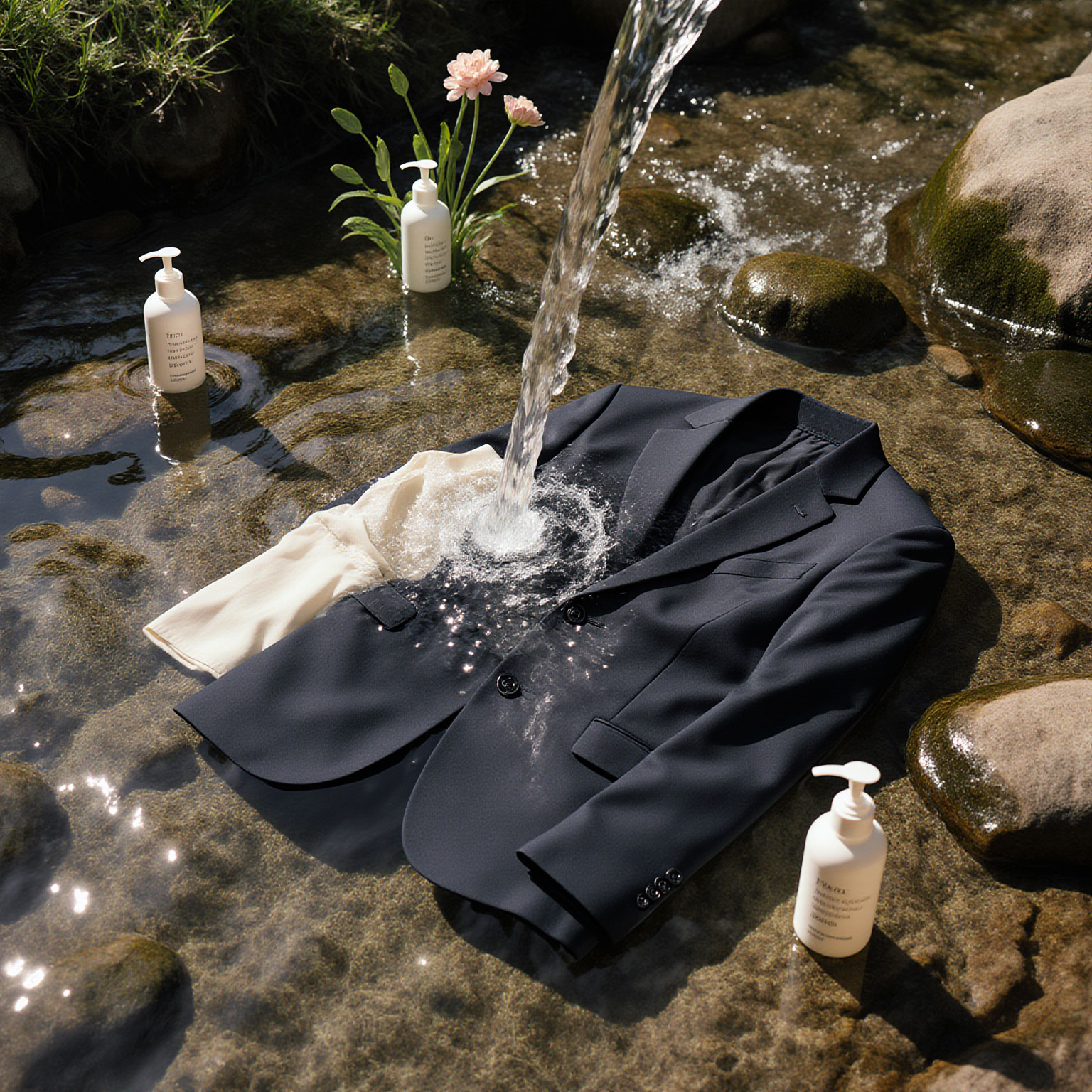
This feels especially true in the world of South Florida dressing, where elegance often depends upon an illusion of effortlessness that is, in reality, quite carefully sustained. The white cotton shirt worn to lunch in Palm Beach. The soft neutral knit packed for a weekend in Harbour Island. The linen suit worn to a spring benefit. The silk caftan drifting through an oceanfront apartment in Surfside. The cashmere wrap carried into overcooled dining rooms in the Design District. The navy dinner jacket worn on a terrace in Coral Gables after dark. These garments are not theatrical costumes for occasional use. They are part of an active, cultivated, socially engaged life. They must perform beautifully in heat, in motion, in close company, and often on little notice.
This is one reason clothing that feels chemically burdened now seems so discordant. It introduces friction into a world that depends on ease. It interrupts the pleasure of dressing. It undermines the sensory confidence that luxury clothing is meant to provide. The wearer may not always articulate the objection in technical terms, but the body registers it at once. A blouse that smells “processed” does not invite intimacy with the fabric. A shirt that feels overly stiff does not encourage relaxed movement. A dress that has lost suppleness no longer collaborates with the body in the same way. And because those who live with beautiful clothes tend to know them well, these small losses are rarely missed.
What is replacing this older standard is not merely a desire for “greener” language, but a more sophisticated understanding of care itself. People want garment care that is intelligent, gentle, and sensorially coherent. They want the finished garment to feel as though it has been respected. Sudsies answers that desire not through abstraction, but through methods designed to protect the relationship between textile and body. Steam-powered spotting, professional wet cleaning where appropriate, fabric-specific finishing, and a discipline of restraint all serve this larger end. The point is not simply that a garment becomes clean. The point is that it returns wearable in the fullest sense of the word.
This becomes especially important with garments that are, by their nature, more intimate in their relationship to the skin. Fine cotton shirting, silk blouses, fluid dresses, lightly structured tailoring, knitwear, cashmere, and soft underlayers all require a sensitivity that goes beyond visual presentation. Their pleasure lies not only in how they look, but in how they move, breathe, and settle against the body. One does not choose a silk camisole solely for its appearance on a hanger. One chooses it for its glide, its coolness, its quiet confidence. One does not choose an extraordinary white shirt only because it looks crisp under a blazer. One chooses it because it feels alive when worn. Garment care that dulls those sensations has missed the point.
The same principle extends into couture, though there it takes on an even more exacting dimension. Couture is often discussed in terms of rarity, expense, and visible craftsmanship, all of which are true enough. But couture is also deeply physical. It is made to sit on the body with extraordinary precision. It responds to posture, gait, gesture, and breath. A couture garment that has been roughly handled may still appear visually intact while losing part of its intended experience. The internal balance shifts. The fabric relaxes incorrectly. The embellishment no longer sits with perfect ease. The result may be subtle, but subtlety is precisely where couture lives.
Sudsies approaches such garments with the understanding that comfort is not separate from preservation. To preserve the integrity of a garment is also to preserve the quality of feeling it offers the wearer. This is why couture garments are often cared for through gentler techniques such as steam-powered spot cleaning and professional wet cleaning. These methods allow for precision without unnecessary aggression. They recognize that the finest garments are not improved by force. They are maintained through knowledge, patience, and a willingness to work with the textile rather than against it.
There is, too, an emotional dimension to clothing that returns beautifully and feels right immediately. It lowers resistance. It restores confidence. It allows the wearer to slip back into a piece without a second thought. In households where dressing is woven into the rhythm of frequent social life, this matters more than one might imagine. The blouse chosen for an impromptu dinner should not need to be “aired out” before it can leave the house. The tuxedo shirt returned for a gala should not feel like a freshly treated object rather than an extension of personal style. The cashmere travel set packed for Aspen should not carry with it the ghost of the process that cleaned it in Miami. True garment care should disappear into the garment itself.
This is one of the quieter luxuries Sudsies offers to its guests, particularly within South Florida’s HNWI community. It is not merely the luxury of convenience, though convenience is certainly present. It is the luxury of continuity. The wardrobe remains in conversation with the life it serves. Items are collected, cared for, and returned without introducing dissonance. The wearer is not asked to adapt to the process after the fact. The process has already adapted itself, intelligently, to the garment.
That standard feels especially resonant now because so much of luxury has become less about overt display and more about private exactitude. The most sophisticated consumer no longer responds only to labels, but to systems. They ask who made something, how it was handled, whether it lasts, how it feels after three years rather than three wears. They are alert to what touches their skin, to what enters their homes, to what lingers in their closets. They want refinement to extend beyond the visible and into the atmospheric. This is where clothing care becomes part of a larger lifestyle philosophy. A beautifully run life is one in which the details nearest the body are considered with as much care as those most publicly seen.
South Florida offers a particularly vivid stage for this shift. The region’s social life is glamorous, certainly, but its private life is equally important. Dressing rooms in waterfront homes. Carefully appointed closets in towers above the bay. Guest suites prepared for extended stays. Resortwear folded beside tailoring. Evening clothes hung near caftans and tennis whites. Wardrobes here are not abstract collections. They are working ecosystems, shaped by travel, climate, entertaining, domestic staff, weekend departures, and the cadence of visible social lives. In such a context, the quality of garment care is immediately legible. One can feel whether a household values gentleness, precision, and comfort. One can feel when care has been outsourced to bluntness.
This is also where the Ecofriendliest proposition becomes particularly persuasive. It does not ask one to surrender luxury in exchange for conscience. It proposes that the most contemporary form of luxury may, in fact, require a more conscientious standard. What is more elegant than a garment cleaned beautifully without the old signs of chemical harshness? What is more modern than clothing that returns fresh, soft, and ready to wear, rather than technically “finished” yet sensorially compromised? What is more aligned with a well-lived life than service that protects both the garment and the pleasure of wearing it?
There is a temptation, in some discussions of sustainability, to speak only in planetary terms. Those terms matter. Yet people also change behavior through immediate, embodied experience. They choose differently when the better option feels better. A shirt that is more comfortable will be worn more often. A dress that returns without harsh odor will be reached for more readily. A jacket whose fabric retains its suppleness will remain part of the wardrobe for years. The body becomes a subtle advocate for better practices. One does not need to read a position paper to know that a garment cleaned gently feels preferable to one that does not.
This is why clothes close to the skin offer such a revealing lens on the future of garment care. They remind us that clothing is not just image. It is contact. It is environment. It is experience. Luxury at its best has always understood this. The best shirtmakers know it. The best knitwear houses know it. The best couturiers know it. Sudsies, in its way, knows it too. Garment care must serve the life of the garment as worn, not merely the garment as displayed.
In this sense, the movement away from harsh solvents and toward gentler, more intelligent care is not simply a technical upgrade. It is a cultural correction. It restores intimacy to the process. It acknowledges that elegance is not only about what others see from across a room, but about what one feels at the precise moment of getting dressed. It recognizes that the well-kept wardrobe is built on comfort as much as appearance, and that comfort itself can be a marker of sophistication.
The old idea of quality garment care may have stopped at visible cleanliness and a sharp finish. The new idea goes further. It asks whether the clothing remains desirable to wear. It asks whether the fabric still carries life. It asks whether the service has respected the body waiting on the other side of the hanger. For Sudsies, that is where the Ecofriendliest standard becomes meaningful. It is not a slogan applied after the work is done. It is a way of ensuring that clothing returns to its owner in the condition most worth preserving: beautiful, fresh, and still deeply itself.
Clothes close to the skin deserve nothing less. And for a guest whose life is composed of movement, beauty, climate, intimacy, and expectation, that standard is no longer a niche preference. It is simply what refinement now requires.