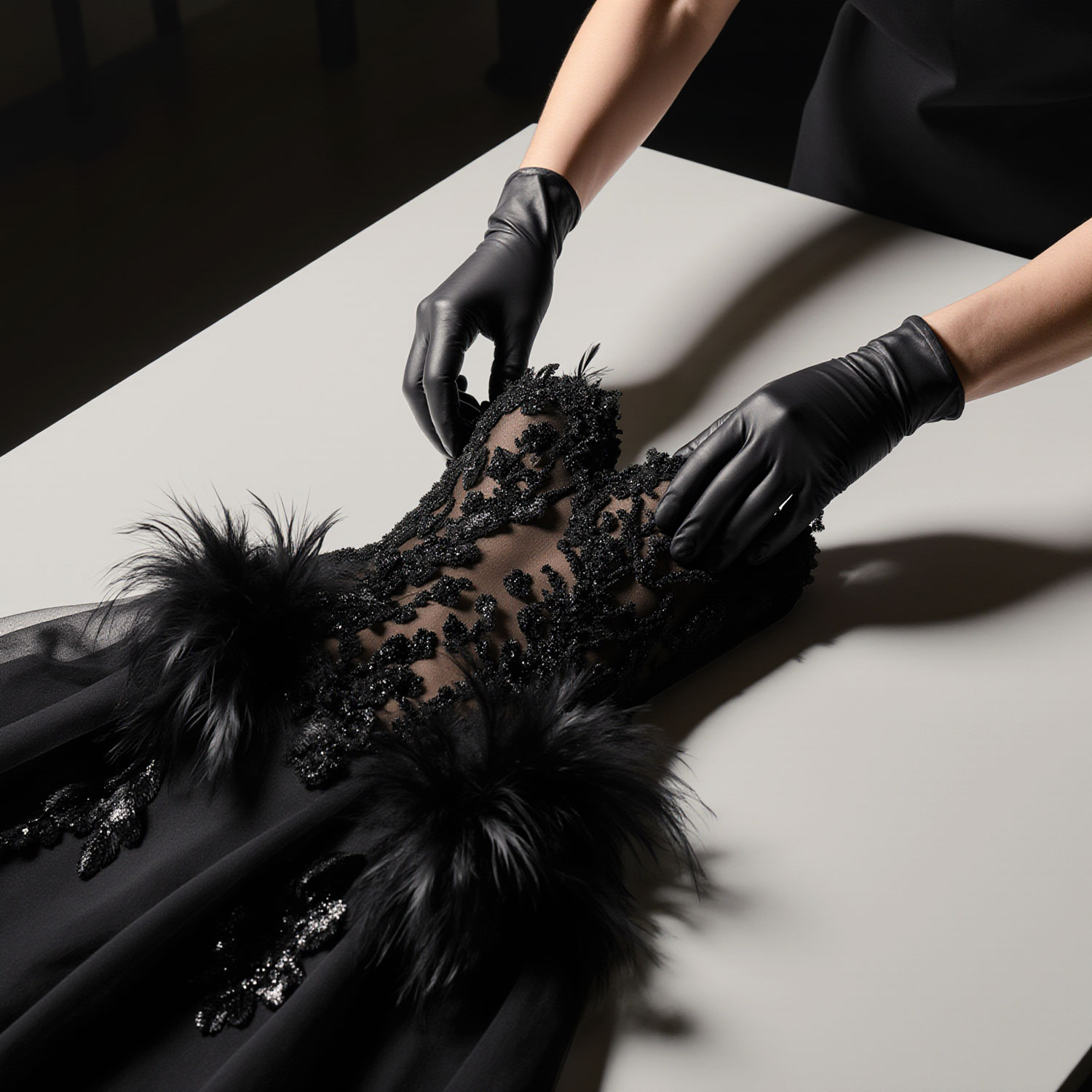


The Stylist’s Guide to Hand-Finished Garments
A stylist rarely has the luxury of judging a garment in theory.
The garment has to work under light. It has to move from rack to fitting room, from hotel suite to car, from car to entrance, from entrance to camera, from camera to dinner, and then somehow return with enough integrity to be worn, stored, shipped, sold, or pulled again. A sleeve that looked fine on the hanger may fail under flash. A blouse that steamed beautifully in the room may cling after twenty minutes outside. A jacket that seemed immaculate at noon may look tired by the time the guest reaches a terrace in Palm Beach.
The final impression depends on details most people never name.
A collar must sit without strain. A lapel must roll instead of flatten. A hem must fall without arguing with the shoe. A pleat must remain intentional. A silk surface must look alive, not pressed into submission. A beaded bodice must keep its shape without losing ease. A trouser must hold enough line for polish, but not so much stiffness that the body disappears inside it.
This is the world of hand-finished garments.
For Sudsies, hand finishing is not a flourish added at the end of cleaning. It is part of the garment’s survival plan, especially in South Florida, where clothes are asked to perform inside chilled rooms, humid air, bright photography, waterfront venues, and long evenings that rarely respect fabric.
The stylist’s problem is presentation under pressure
A guest may think the question is simple.
Does the garment look clean?
A stylist knows the better question.
Will the garment hold?
Will it hold through sitting, standing, walking, greeting, dining, hugging, being photographed, being moved by a handler, being packed into a garment bag, being retrieved from a car, being exposed to humidity, and being seen from every possible angle?
South Florida adds its own complications. A gown prepared in an air-conditioned residence in Coral Gables may meet damp air before the guest reaches the valet. A silk shirt worn under a jacket in Brickell may absorb body heat before the first meeting ends. A dress bound for Miami Beach may encounter sunscreen, fragrance, salt air, makeup, and terrace humidity within the same evening. A jacket worn in Fisher Island or Palm Beach may pass through more climate changes in two hours than it would in a full day elsewhere.
The garment’s finish must be prepared for that movement.
That is why stylists need a care partner who understands that finishing is not cosmetic. It determines how the garment behaves in real life.
Smooth is not always correct
A garment can be smooth and still be wrong.
This is one of the first things a good stylist learns. Too much pressure can make a soft jacket look cheaper. Too much steam can disturb a sculpted bodice. Too much sharpness can remove the relaxed authority from a fine shirt. Too much heat can change the surface of silk, wool, satin, or specialty blends. A crease added in the wrong place can make the garment look obedient rather than elegant.
Ordinary pressing often pursues flatness. Hand finishing pursues intention.
Some garments need architecture. Others need air. Some want definition at the edge. Others want softness through the body. A hand-finished garment may depend on a barely visible curve, a relaxed roll, a lifted shoulder, a released skirt, or the exact amount of ease at the cuff.
Sudsies approaches these choices garment by garment. The team considers fabric, construction, embellishment, lining, prior wear, alterations, and the next use of the piece. The question is not how to make the garment look “done.” The question is how to return it to the version of itself the stylist can actually use.
Couture wet cleaning changes the conversation
Hand-finished garments often require more than careful finishing after the fact. They require the right cleaning path from the beginning.
For couture and certain high-value pieces, Sudsies uses an artisanal wet cleaning process rather than ordinary dry cleaning. This work happens under the experienced eyes and hands of a couture specialist who understands that moisture, spotting, drying, and finishing must be controlled with unusual care.
The process depends on education, intuition, and repetition. A specialist evaluates how the garment was made, where stress has collected, what the fabric can tolerate, how embellishments respond, whether dye stability presents risk, and how the garment should be finished after cleaning. A delicate silk dress, a hand-finished jacket, a beaded gown, a pleated skirt, and a vintage piece from an auction or estate wardrobe may each require a different path.
That is why the care process begins before anything touches the garment.
A stylist who provides context improves the outcome. Sudsies should know whether the garment was worn outdoors, steamed before an event, pinned during a fitting, packed in luggage, photographed under heat, exposed to rain, touched by makeup, or treated with a product backstage or at home. The garment may not volunteer its history, but it often shows evidence to someone trained to look.
Intake notes can protect the whole look
Stylists live by notes.
Hem needs review. Client prefers no hard crease. Keep sleeve soft. Do not flatten lapel. Watch shoulder. Check makeup at neckline. Beading at left side feels loose. Garment was pinned at waist. Worn once outside. Needs to travel Friday. Photographing under bright light. Return ready for event.
Those notes matter.
Sudsies can use them to understand the garment’s intended presentation, not merely its condition. A care team may see a jacket. A stylist sees the jacket in relation to the client’s body, the event, the shoe, the jewelry, the light, and the photograph. The more Sudsies understands that context, the more precisely the garment can be cleaned, finished, and returned.
This is especially important for garments with soft tailoring, unusual closures, lace, appliqué, stones, feathers, metallic thread, structured bodices, delicate linings, or previous alterations. A garment that looks simple may be technically difficult. A garment that looks dramatic may be more stable than expected. Assumptions help no one.
Inspection and communication make the difference.
The fitting room creates its own risks
A garment can be compromised before the event ever begins.
Fittings introduce pins, clips, makeup, fragrance, floor contact, handling, body heat, and repeated on-and-off movement. A white blouse may pick up foundation at the collar. A gown hem may gather dust before anyone sees it. A jacket may stretch slightly from being tried on too many times. A trouser may develop pressure at the waistband. A delicate fabric may snag against jewelry or a zipper from another garment on the rack.
In South Florida, the room itself matters. Garments often move between refrigerated interiors and humid loading areas. They may wait in cars, hotel rooms, backstage spaces, residences, boutiques, or elevators. The most dangerous period is not always the event. Sometimes it is the preparation.
A stylist should look at the garment before and after each use, not only when something obvious happens. Sudsies can help determine whether the garment needs cleaning, finishing, repair, alteration, or simply a careful refresh before the next appearance.
What hand finishing protects
Hand finishing protects the parts of a garment that ordinary language often misses.
It protects the quiet lift in a shoulder. It protects the intended break in a trouser. It protects the curve of a lapel. It protects the weight of a hem. It protects the openness of a pleat. It protects the surface of silk. It protects the relationship between lining and outer fabric. It protects the ease that makes an expensive garment look natural on the person wearing it.
These are small things until they disappear.
Once a garment has been over-pressed, overheated, over-steamed, or finished without respect for construction, the result may not look damaged to everyone. It may simply look less convincing. Stylists notice that difference immediately because the garment no longer supports the image.
Sudsies treats hand finishing as a technical act with aesthetic consequences. The work should not call attention to itself. It should restore the garment’s usefulness to the stylist and confidence to the guest.
The South Florida stylist’s pre-care checklist
Before sending a hand-finished garment to Sudsies, a stylist should take a slow look at the areas most likely to betray wear.
The neckline, collar, cuffs, underarms, waistband, hem, seat, lining, closures, pocket edges, sleeve heads, and embellishment points deserve attention. Makeup, deodorant, sunscreen, fragrance, perspiration, food oils, drink residue, candle smoke, and moisture often appear first in these places.
The next question is where the garment goes after care.
A garment being returned to a client for dinner needs a different finishing conversation from one being packed for travel, stored for the season, photographed for resale, sent to a residence, or held for a second event. Sudsies can prepare the garment more intelligently when the next destination is known.
For many South Florida guests, that destination may not be one closet. Garments move between Miami, Palm Beach, Boca Raton, Hobe Sound, New York, Aspen, London, the Bahamas, and seasonal residences. A stylist’s care plan should account for that movement before the garment leaves the room.
What stylists should avoid
Urgency can be unkind to beautiful clothes.
A rushed steam can relax structure that should have stayed shaped. A heavy press can remove softness from tailoring. A home stain product can leave a ring larger than the original mark. A damp garment placed into plastic can create a storage problem by morning. A beaded gown hung carelessly can strain under its own weight. A silk dress treated too confidently can lose the surface quality that made it worth choosing.
Stylists are often asked to solve problems quickly, but certain garments need restraint more than intervention.
When something happens, Sudsies needs the facts. What touched the garment? When did it happen? Was water used? Was heat applied? Was the garment steamed? Was it pinned? Was it worn near water? Was it stored in plastic? Did it come from resale, auction, consignment, or an estate wardrobe?
A correct answer can save time. An incorrect assumption can cost the garment.
Resale, loans, and the second life of garments
Stylists increasingly work with garments that are not moving in a straight line from boutique to closet.
A client may purchase through Chaîné, acquire a piece through The RealReal, find menswear through Grailed, buy at an estate sale in Palm Beach, or source a significant fashion piece through Christie’s or Sotheby’s. Other garments may be borrowed, lent, photographed, returned, archived, sold, or kept in rotation between residences.
This changes the care standard.
A garment with more than one life may carry prior fragrance, old perspiration, oxidation, storage odor, weakened seams, undocumented alterations, or earlier cleaning attempts. It may need professional inspection before styling, not after. A garment intended for resale or long-term collection also needs finishing that respects condition, not merely appearance.
Sudsies helps stylists protect both the immediate look and the garment’s future value.
PRO TIP
For stylists managing significant garments after an event, shoot, client appearance, or resale acquisition, Sudsies can arrange seamless transportation of finished pieces to UOVO Fashion in Palm Beach for long-term museum-quality storage.
This is especially useful for couture, hand-finished garments, vintage pieces, embellished gowns, rare menswear, and wardrobe items that need climate-conscious stewardship after Sudsies care. A garment should not move from careful cleaning and finishing into casual storage. It should continue into an environment suited to its value, construction, and future use.
For a stylist, this creates a cleaner chain of care: prepare the garment, dress the guest, recover the piece, send it to Sudsies, finish it properly, then store it with the seriousness it deserves.
When the garment leaves South Florida
Stylists rarely work inside one geography anymore.
A garment may be chosen in Miami, fitted in Palm Beach, photographed in New York, worn in Aspen, shipped from London, or returned to a client’s seasonal residence. Travel introduces compression, wrinkles, odor, friction, humidity, and uncertainty. A garment that looked settled in a fitting room may arrive with a bruised hem, tired sleeve, distorted shoulder, or lining that has absorbed the journey.
Sudsies Express gives stylists and guests access to Sudsies garment care beyond South Florida through FedEx shipping. This allows care continuity for garments that move with the client rather than remaining where they were first cleaned.
For stylists, continuity is not a luxury. It is how standards survive travel.
Why Sudsies works for stylists
Sudsies understands that stylists are not asking only for clean garments.
They are asking for garments that return usable. Ready for a body. Ready for a room. Ready for a photograph. Ready for travel. Ready for storage. Ready for the next decision.
That requires care with judgment. Sudsies inspects fabric, construction, embellishment, finish, prior wear, provenance, and guest preferences before the cleaning process begins. Couture garments and hand-finished pieces may require artisanal wet cleaning, careful spotting, controlled drying, and hand-finishing performed according to the garment’s actual needs.
The best result is quiet.
The guest notices that the garment feels right. The stylist notices that nothing has been overworked. The camera notices nothing at all, which is often the highest compliment.
Sudsies protects that kind of finish.
Frequently Asked Questions
What is a hand-finished garment?
A hand-finished garment is a piece whose final presentation depends on skilled manual care rather than routine mechanical finishing. This can include couture garments, bespoke tailoring, soft jackets, silk dresses, beaded gowns, pleated garments, hand-finished shirts, and designer pieces with construction details that require careful judgment.
How is hand finishing different from regular pressing?
Regular pressing often focuses on smoothness. Hand finishing focuses on the garment’s intended shape, line, surface, movement, and proportion. Sudsies uses hand finishing when standard heat, pressure, or speed could flatten structure, disturb fabric, or change the way the garment is meant to sit on the body.
Does Sudsies use dry cleaning for hand-finished garments?
For couture and certain high-value hand-finished garments, Sudsies may use an artisanal wet cleaning process rather than ordinary dry cleaning. This process is performed under the experienced eyes and hands of a couture specialist who evaluates fabric, construction, embellishment, prior wear, and risk before care begins.
Why should stylists provide garment notes to Sudsies?
Garment notes help Sudsies protect the intended presentation of the piece. Details about prior wear, fitting pins, makeup exposure, steaming, travel, alterations, water exposure, or client preferences can change how the garment should be cleaned, dried, and finished.
Should hand-finished garments be cleaned after every event?
Not automatically. Some garments should be cleaned after one wear because they encountered perspiration, fragrance, sunscreen, food, drink, humidity, smoke, or travel. Other garments may need inspection, finishing, or targeted care. Sudsies can help determine the safest choice.
Can Sudsies help with garments sourced from resale, auctions, or estate sales?
Yes. Garments sourced through estate sales, private sellers, Chaîné, The RealReal, Grailed, Christie’s, Sotheby’s, and other resale or auction channels may carry older stains, fragrance, storage odor, weakened seams, undocumented alterations, or prior cleaning attempts. Sudsies recommends careful inspection before wearing, altering, cleaning, or storing them.
Can Sudsies coordinate museum-quality storage after cleaning and finishing?
Yes. Sudsies can arrange seamless transportation of finished garments to UOVO Fashion in Palm Beach for long-term museum-quality storage of fine items. This is especially useful for couture, hand-finished garments, event pieces, vintage fashion, and collector wardrobes.
Can Sudsies care for hand-finished garments outside South Florida?
Yes. Sudsies Express provides access to Sudsies garment care for guests and stylists beyond South Florida through FedEx shipping. This supports garments that move between cities, residences, events, and seasonal wardrobes.